The Maurya Empire (322 – 185 B.C.E.), ruled by the Mauryan dynasty, was a geographically extensive and powerful political and military empire in ancient India. Originating from the kingdom of Magadha in the Indo-Gangetic plains of modern Bihar, Eastern Uttar Pradesh and Bengal, the empire's capital city was at Pataliputra near modern Patna. Chandragupta Maurya founded the Empire in 322 B.C.E. after overthrowing the Nanda Dynasty. He began rapidly expanding his power westward across central and western India. Local powers had been disrupted by the westward withdrawal of Alexander the Great's and his Macedonianand Persian armies. By 316 B.C.E. the empire had fully occupied Northwestern India, defeating and conquering the satraps left by Alexander.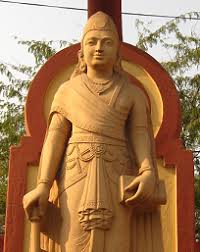
At its zenith, the Empire stretched to the northern natural boundaries of the Himalaya Mountains, and to the east into Assam. To the west, it reached beyond modern Pakistan and significant portions of Afghanistan, including the modern Herat and Kandahar provinces and Balochistan. Emperor Bindusara expanded the Empire into India's central and southern regions, but it excluded a small portion of unexplored tribal and forested regions near Kalinga, India.
The Mauryan Empire was arguably the largest empire to rule the Indian subcontinent. Its decline began fifty years after Ashoka's rule ended, and it dissolved in 185 B.C.E. with the rise of the Sunga Dynasty in Magadha. Under Chandragupta, the Mauryan Empire conquered the trans-Indus region, defeating its Macedonian rulers. Chandragupta then defeated the invasion led by Seleucus I, a Greek general from Alexander's army. Under Chandragupta and his successors internal and external trade, and agriculture and economic activities, all thrived and expanded across India. Chadragupta created a single and efficient system of finance, administration, and security. The Mauryan empire stands as one of the most significant periods in Indian history.

After the Kalinga War, the Empire experienced a half century of peace and security under Ashoka. India was a prosperous and stable empire of great economic and military power. Its political and trade influence extended across Western and Central Asia into Europe. During that time Mauryan India also enjoyed an era of social harmony, religious transformation, and expansion of learning and the sciences. Chandragupta Maurya's embrace of Jainism increased social and religious renewal and reform across his society. Ashoka's embrace of Buddhism was the foundation of social and political peace and non-violence across all of India. The era fostered the spread of Buddhist ideals into Sri Lanka, Southeast Asia, West Asia, and Mediterranean Europe.
Chandragupta's minister Kautilya Chanakya wrote the Arthashastra, considered one of the greatest treatises on economics, politics, foreign affairs, administration, military arts, war, and religion ever produced. Archaeologically, the period of Mauryan rule in Southern Asia falls into the era of Northern Black Polished Ware (NBPW). The Arthashastra and the Edicts of Ashoka serve as primary sources of written records of the Mauryan times. The Lion Capital of Asoka at Sarnath, remains the emblem of India.
Background
Alexander set up a Macedonian garrison and satrapies (vassal states) in the trans-Indus region of modern day Pakistan, ruled previously by kings Ambhi of Taxila and Porus of Pauravas (modern day Jhelum).
Chanakya and Chandragupta Maurya
Following Alexander's advance into the Punjab, a brahmin named Chanakya (real name Vishnugupt, also known as Kautilya) traveled to Magadha, a kingdom large and militarily-powerful and feared by its neighbors, but its king Dhana, of the Nanda Dynasty, dismissed him. The prospect of battling Magadha deterred Alexander's troops from going further east: He returned to Babylon, and re-deployed most of his troops west of the Indus river. When Alexander died in Babylon, soon after in 323 B.C.E., his empire fragmented, and local kings declared their independence, leaving several smaller satraps in a disunited state. Chandragupta Maurya deposed Dhana. The Greek generals Eudemus, and Peithon, ruled until around 316 B.C.E., when Chandragupta Maurya (with the help of Chanakya, now his adviser) surprised and defeated the Macedonians and consolidated the region under the control of his new seat of power in Magadha.


Mystery and controversy shroudsChandragupta Maurya's rise to power. On the one hand, a number of ancient Indian accounts, such as the drama Mudrarakshasa (Poem of Rakshasa-Rakshasa was the prime minister of Magadha) by Visakhadatta, describe his royal ancestry and even link him with the Nanda family. the earliest Buddhist texts, Mahaparinibbana Sutta refer to a kshatriya tribe known as the Maurya.
Any conclusions require further historical evidence. Chandragupta first emerges in Greek accounts as "Sandrokottos." As a young man he may have met Alexander. Accounts say that he also met the Nanda king, angered him, and made a narrow escape. Chanakya originally intended to train a guerrilla army under Chandragupta's command. The Mudrarakshasa of Visakhadutta, as well as the Jaina work Parisishtaparvan,discuss Chandragupta's alliance with the Himalayan king Parvatka, sometimes identified with Porus. That Himalayan alliance gave Chandragupta a composite and powerful army made up of Yavanas (Greeks), Kambojas, Shakas (Scythians), Kiratas (Nepalese), Parasikas (Persians), and Bahlikas (Bactrians). With the help of those frontier martial tribes from Central Asia, Chandragupta defeated the Nanda/Nandin rulers of Magadha and founded the powerful Maurya empire in northern India.
Conquest of Magadha
Chanakya encouraged Chandragupta and his army to take over the throne of Magadha. Using his intelligence network, Chandragupta gathered many young men from across Magadha and other provinces, men upset over the corrupt and oppressive rule of king Dhana, plus resources necessary for his army to fight a long series of battles. Those men included the former general of Taxila, other accomplished students of Chanakya, the representative of King Porus of Kakayee, his son Malayketu, and the rulers of small states.
Preparing to invade Pataliputra, Maurya hatched a plan. He had a battle announced and the Magadhan army mustered from the city to a distant battlefield to engage Maurya's forces. Maurya's general and spies meanwhile bribed the corrupt general of Nanda. He also managed to create an atmosphere of civil war in the kingdom, which culminated in the death of the heir to the throne. Chanakya managed to win over popular sentiment. Ultimately Nanda resigned, handing power to Chandragupta, went into exile and disappeared from history.
Chanakya contacted the prime minister, Rakshasa, and made him understand that he owed loyalty to Magadha rather than to the Magadha dynasty, insisting that he continue in office. Chanakya also reiterated that choosing to resist would start a war that would severely affect Magadha and destroy the city. Rakshasa accepted Chanakya's reasoning, and Chandragupta Maurya was legitimately installed as the new King of Magadha. Rakshasa became Chandragupta's chief adviser, and Chanakya assumed the position of an elder statesman.


Building India's First Empire
Having become the king of one of India's most powerful states, Chandragupta invaded the Punjab. One of Alexander's richest satraps, Peithon, satrap of Media, had tried to raise a coalition against him. Chandragupta managed to conquer the Punjab capital of Taxila, an important center of trade and Hellenistic culture, increasing his power and consolidating his control.
Chandragupta Maurya
Chandragupta again fought with the Greeks when Seleucus I, ruler of the Seleucid Empire, tried to reconquer the northwestern parts of India, during a campaign in 305 B.C.E., but failed. The two rulers finally concluded a peace treaty: A marital treaty (Epigamia), implying either a marital alliance between the two dynastic lines or a recognition of marriage between Greeks and Indians. Chandragupta received the satrapies of Paropamisadae (Kamboja and Gandhara), Arachosia (Kandhahar), and Gedrosia (Balochistan), and Seleucus I received 500 war elephants that would play a decisive role in his victory against western Hellenistic kings at the Battle of Ipsus in 301 B.C.E.Diplomatic relations established, several Greeks, such as the historian Megasthenes, Deimakos, and Dionysius, resided at the Mauryan court.
Chandragupta established a strong centralized state with a complex administration at Pataliputra, which, according to Megasthenes, was "surrounded by a wooden wall pierced by 64 gates and 570 towers—(and) rivaled the splendors of contemporaneous Persian sites such as Susa and Ecbatana." Chandragupta's son Bindusara extended the rule of the Mauryan empire towards southern India. He also had a Greek ambassador, Deimachus (Strabo 1–70), at his court. Megasthenes described a disciplined multitude under Chandragupta, who live simply, honestly, and do not know writing.
Bindusara
Chandragupta died after reigning for twenty four years. His son, Bindusara, also known as Amitrochates (destroyer of foes) in Greek accounts, succeeded him in 298 B.C.E. Little information regarding Bindusara exists. Still, some credit him with the incorporation of the southern peninsular India. According to Jain tradition, his mother was a woman by the name of Durdhara. The Puranas assign him a reign of twenty five years. He has been identified with the Indian title Amitraghata (slayer of Enemies), found in Greek texts as Amitrochates.

No comments:
Post a Comment