Shah Shuja (23 June 1616 – 7 February 1661) was the second son of the Mughal emperor Shah Jahan and empress Mumtaz Mahal.her daughter princess pazir banu begum was married to Aurangzeb
Early life and family

Shah Shuja was born on 23 June 1616, in Ajmer. He was the second son and child of Mughal emperor Shah Jahan and his queen Mumtaz Mahal.
Shuja's siblings were Jahanara Begum, Dara Shikoh, Roshanara Begum, Aurangzeb, Murad Baksh,Gauhara Begum and others. He had three sons - Sultan Zain-ul-Din (Bon Sultan or Sultan Bang), Buland Akhtar and Zainul Abidin and four daughters - Gulrukh Banu, Roshanara Begum and Amina Begum.
Marriage
He married to princess paira banu begum,daughter of raja gur sen of khihtwar and biqis begum
Governor of Bengal
Shuja was appointed by Shah Jahan as the Subahdar of Bengal and Bihar from 1641 and of Orissa from 25 July 1648 until 1661. During his governorship, he built the official residence Bara Katra in the capital Dhaka.
After the illness of Shah Jahan in September 1657, a power crisis occurred among the brothers. Shah Shuja proclaimed himself as Emperor, but Aurangzeb ascended the throne of Dheli and sent Mir Jumla to subjugate Shuja. Shuja was defeated in the Battle of Khajwa on 5 January 1659. He retreated first to Tandah and then to Dhaka on 12 April 1660. He left Dhaka on 6 May and boarded ships near present-day Bhulua on 12 May heading Arakan. Mir Jumla reached Dhaka on 9 May 1660 and was then appointed by Aurangzeb as the next Subahdar of Bengal.
Mughal war of succession

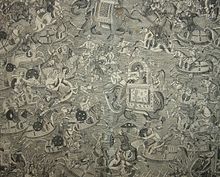
When Shah Jahan fell ill, a struggle for the throne started between his four sons - Dara Shikoh, Shah Shuja, Aurangzeb and Murad Baksh. Shuja immediately crowned himself the emperor and took imperial titles, November 1657.
He marched with a large army, backed by a good number of war-boats in the river Ganges. However, he was beaten by Dara's army in a hotly contested Battle of Bahadurpur near Banares (in modern Uttar Pradesh, India). Shuja turned back to Rajmahal to make further preparations. He signed a treaty with his elder brother Dara, which left him in control of Bengal, Orissa and a large part of Bihar, 17 May 1658.
In the meantime, Aurangzeb defeated Dara twice (at Dharmat and Samugarh), caught him, executed him on a charge of heresy and ascended the throne. Shuja marched again to the capital, this time against Aurangzeb. A battle took place on 5 January 1659 at theBattle of Khajwa (Fatehpur district, Uttar Pradesh, India) where Shuja was defeated.
After his defeat, Shuja retreated towards Bengal. He was pursued by the imperial army under Mir Jumla. Shuja put up a good fight against them. However, he was finally defeated in the last battle in April 1660. After each defeat he had to face desertions in his own army, but he did not lose heart. He, rather, reorganised the army with renewed vigor. But when he was going to be surrounded at Tandah, and when he found that reorganisation of the army was no longer possible, he decided to leave Bengal for good and take shelter in Arakan.

No comments:
Post a Comment