Sunday, 1 May 2016

1984 June 6 Indian army storms Golden Temple

In a bloody climax to two years of fighting between the Indian government and Sikh separatists, Indian army troops fight their way into the besieged Golden Temple compound in Amritsar–the holiest shrine of Sikhism–and kill at least 500 Sikh rebels. More than 100 Indian soldiers and scores of nonbelligerent Sikhs also perished in the ferocious gun and artillery battle, which was launched in the early morning hours of June 6. The army also attacked Sikh guerrillas besieged in three dozen other temples and religious shrines throughout the state of Punjab. Indian officials hailed the operation as a success and said it “broke the back” of the Sikh terrorist movement.
Image result for Indian army storms Golden Temple images The Sikh religion, which was founded in the late 15th century by Guru Nanak, combines elements of Hinduism and Islam, the two major religions of India. The religion is centered on the Indian state of Punjab in northern India, where Sikhs comprise a majority and speak Punjabi. In the 1970s, agricultural advances made Punjab one of India’s most prosperous states, and Sikh leaders began calling for greater autonomy from the central government.

 This movement was largely peaceful until 1982, when the Sikh fundamentalist Jarnail Singh Bhindranwale and his followers launched a separatist campaign in Punjab. Employing terrorism and assassination, Bhindranwale and his guerrillas killed scores of political opponents and Hindu civilians in the name of establishing an autonomous Sikh Khalistan, or “Land of the Pure.” Most Sikhs did not support Bhindranwale’s violent campaign, in which the extremists also assassinated several Sikhs who spoke out against the creation of Khalistan.To appease the Sikhs, Indian Prime Minister Indira Gandhi nominated Zail Singh to be the first Sikh president of India in 1982, a significant choice because the Sikhs comprise a small percentage of India’s overall population. Most Sikhs distrusted Singh, however, because as Indian head of state he generally supported Gandhi’s policies. Meanwhile, the separatists occupied the Golden Temple and other Sikh holy sites and turned them into armed bases.
Image result for Indian army storms Golden Temple images
The Golden Temple, known as the Harimandir in India, was built in 1604 by Guru Arjun. It was destroyed several times by Afghan invaders and rebuilt in the early 19th century in marble and copper overlaid with gold foil. The temple occupies a small island in the center of a pool. There are a number of other important buildings in the 72-acre temple compound, including the Akal Takht, which is the repository for Sikhism’s Holy Book of scriptures and the headquarters of the religion.
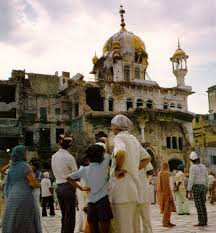
Image result for Indian army storms Golden Temple images
To suppress the separatist revolt, which had claimed more than 400 Hindu and Sikh lives and virtually shut down Punjab, Prime Minister Gandhi ordered Indian troops to seize control of the Sikh bases by force in June 1984. On June 1, army troops surrounded the Golden Temple and exchanged gunfire with the rebels, who were heavily armed and commanded by a high-ranking army defector. The Sikhs refused to surrender, and in the early morning of June 6 army forces launched an assault on the temple compound. By daylight, the Sikhs were defeated.
Jarnail Singh Bhindranwale, the rebel leader, perished in the attack, allegedly by his own hand. The Indian government announced that 492 Sikh militants were killed, but the Sikhs put the number at more than 1,000. More than 100 army troops were killed and several hundred wounded. More than 1,500 Sikhs were arrested in the operation. The Golden Temple itself suffered only minor damage, but the Akal Takht, a scene of heavy fighting, was heavily damaged.
In the aftermath of the bloody confrontation, Sikhs rioted across India, and more people were killed. Some 1,000 Sikh soldiers in the Indian army mutinied, but these defectors were suppressed, and rebel leaders still at large were captured or killed. On October 31, in a dramatic act of retaliation, Indira Gandhi was shot to death in her garden by two Sikh members of her own bodyguard. This act only led to further violence, and thousands of Sikhs were massacred by angry Hindus in Delhi before Gandhi’s son and successor, Rajiv Gandhi, called out the army to end the orgy of violence. Punjab’s political status remained a divisive issue in India, and disorder and violence persisted in the state until the early 1990s.

1984 October 31 assassination of Indira Gandhi


1984: Indian prime minister shot dead
Image result for indira gandhi images
Indira Gandhi, the Prime Minister of India, has been killed by assassins in New Delhi.Mrs Gandhi was thought to have been walking through her gardens this morning when she was shot. She was taken to the All India Medical Hospital where she underwent an emergency operation to remove the bullets but died an hour and a half later.
Initial reports suggest the two attackers were guards at her home who were then shot by other security officers.
No exact motive is known but it is believed the pair were Sikh extremists acting in retaliation for the storming of the Sikh holy shrine of the Golden Temple in Amritsar in June.
Mrs Gandhi had been receiving death threats since the attack on the temple in which 1,000 people died.
The night before her death she told a political rally: "I don't mind if my life goes in the service of the nation. If I die today, every drop of my blood will invigorate the nation."
Security throughout the country has been stepped up. Roads to the hospital and the home of the prime minister have been sealed off and borders around Delhi have been closed.


If I die today, every drop of my blood will invigorate the nation
Indira Gandhi
The Indian cabinet has started an emergency meeting to choose a successor.
India's High Commissioner, Prakash Mehrotra, said: "Democracy is very deep rooted in our country and the country is prepared to face any situation. A meeting is being called in Delhi, it is usual that the number two man in the cabinet takes charge for the time being,"
Mrs Gandhi first became prime minister in 1966 and again in 1980 and was praised for her battle against famine in rural areas.
Stan Orme from the Anglo Indian Parliamentary Association said: "It is a very terrible thing. She was a very impressive person, very strong-willed. It is a real tragedy."

1997 September 6 death of Mother Teresa

Agnes Gonxha Bojaxhiu, the future Mother Teresa, was born on 26 August 1910, in Skopje, Macedonia, to Albanian heritage. Her father, a well-respected local businessman, died when she was eight years old, leaving her mother, a devoutly religious woman, to open an embroidery and cloth business to support the family. After spending her adolescence deeply involved in parish activities, Agnes left home in September 1928, for the Loreto Convent in Rathfarnam (Dublin), Ireland, where she was admitted as a postulant on October 12 and received the name of Teresa, after her patroness, St. Therese of Lisieux. 
Agnes was sent by the Loreto order to India and arrived in Calcutta on 6 January 1929. Upon her arrival, she joined the Loreto novitiate in Darjeeling. She made her final profession as a Loreto nun on 24 May 1937, and hereafter was called Mother Teresa. While living in Calcutta during the 1930s and '40s, she taught in St. Mary's Bengali Medium School.

On 10 September 1946, on a train journey from Calcutta to Darjeeling, Mother Teresa received what she termed the "call within a call," which was to give rise to the Missionaries of Charity family of Sisters, Brothers, Fathers, and Co-Workers. The content of this inspiration is revealed in the aim and mission she would give to her new institute: "to quench the infinite thirst of Jesus on the cross for love and souls" by "labouring at the salvation and sanctification of the poorest of the poor." On October 7, 1950, the new congregation of the Missionaries of Charity was officially erected as a religious institute for the Archdiocese of Calcutta.

Throughout the 1950s and early 1960s, Mother Teresa expanded the work of the Missionaries of Charity both within Calcutta and throughout India. On 1 February 1965, Pope Paul VI granted the Decree of Praise to the Congregation, raising it to pontifical right. The first foundation outside India opened in Cocorote, Venezuela, in 1965. The Society expanded to Europe (the Tor Fiscale suburb of Rome) and Africa (Tabora, Tanzania) in 1968.
Image result for death of Mother Teresa images

From the late 1960s until 1980, the Missionaries of Charity expanded both in their reach across the globe and in their number of members. Mother Teresa opened houses in Australia, the Middle East, and North America, and the first novitiate outside Calcutta in London. In 1979 Mother Teresa was awarded the Nobel Peace Prize. By that same year there were 158 Missionaries of Charity foundations.

The Missionaries of Charity reached Communist countries in 1979 with a house in Zagreb, Croatia, and in 1980 with a house in East Berlin, and continued to expand through the 1980s and 1990s with houses in almost all Communist nations, including 15 foundations in the former Soviet Union. Despite repeated efforts, however, Mother Teresa was never able to open a foundation in China.
Image result for death of Mother Teresa images

Mother Teresa spoke at the fortieth anniversary of the United Nations General Assembly in October 1985. On Christmas Eve of that year, Mother Teresa opened "Gift of Love" in New York, her first house for AIDS patients. In the coming years, this home would be followed by others, in the United States and elsewhere, devoted specifically for those with AIDS.

From the late 1980s through the 1990s, despite increasing health problems, Mother Teresa travelled across the world for the profession of novices, opening of new houses, and service to the poor and disaster-stricken. New communities were founded in South Africa, Albania, Cuba, and war-torn Iraq. By 1997, the Sisters numbered nearly 4,000 members, and were established in almost 600 foundations in 123 countries of the world.
Image result for death of Mother Teresa images

After a summer of travelling to Rome, New York, and Washington, in a weak state of health, Mother Teresa returned to Calcutta in July 1997. At 9:30 PM, on 5 September, Mother Teresa died at the Motherhouse. Her body was transferred to St Thomas's Church, next to the Loreto convent where she had first arrived nearly 69 years earlier. Hundreds of thousands of people from all classes and all religions, from India and abroad, paid their respects. She received a state funeral on 13 September, her body being taken in procession - on a gun carriage that had also borne the bodies of Mohandas K. Gandhi and Jawaharlal Nehru - through the streets of Calcutta. Presidents, prime ministers, queens, and special envoys were present on behalf of countries from all over the world.

527 B.C.E Death of Mahavira


Mahavira( Sanskrit: “Great Hero”) also known as Vardhamana (born c. 599 bcetraditional dating, Kshatriyakundagrama, India—died 527 traditional dating, Pavapuri) Epithet of Vardhamana, the last of the 24 Tirthankaras (“Ford-makers,” i.e., saviours who promulgated Jainism), and the reformer of the Jain monastic community. According to the traditions of the two main Jain sects, theShvetambara (“White-robed”) and the Digambara (“Sky-clad,” i.e., naked), Mahavira became a monk and followed an extreme ascetic life, attainingkevala, the stage of omniscience or highest perception. Teaching a doctrine of austerity, Mahavira advocated nonviolence (ahimsa) in all circumstances and the acceptance of the mahavratas, the five “great vows” of renunciation.

Life

Although tradition dictates that Mahavira was born about 599 bce, many scholars believe this date to be as much as 100 years early, in that Mahavira probably lived at about the same time as the Buddha, whose traditional birth date has also been reassessed. The son of a Kshatriya (warrior caste) family, he grew up in Kshatriyakundagrama, a suburb of Vaishali (modern Basarh, Biharstate), where both Jainism and Buddhism originated. His father was Siddhartha, a ruler of the Nata, or Jnatri, clan. According to one Jain tradition, his mother was Devananda, a member of the Brahman (priestly) caste; other traditions call her Trishala, Videhadinna, or Priyakarini and place her in the Kshatriya caste.
The 7th to 5th century bce was a period of great intellectual, philosophical, religious, and social ferment in India, a time when members of the Kshatriya caste opposed the cultural domination of theBrahmans, who claimed authority by virtue of their supposed innate purity. In particular, there was growing opposition to the large-scale Vedic sacrifices (yajna) that involved the killing of many animals. Because of the popularity of the doctrine of continual rebirth, which linked animals and humans in the same cycle of birth, death, and rebirth, unnecessary killing had become objectionable to many people. Economic factors may also have encouraged the growth of the doctrine of nonviolence. The leaders of the anti-Brahman sects came to be regarded as heretical. Mahavira and his contemporary Siddhartha Gautama, the Buddha, were two of the greatest leaders in this movement.
Image result for Death of Mahavira images
Although accounts of the life of Mahavira vary for the two Jain sects, he apparently was reared in luxury, but because he was a younger son he could not inherit the leadership of the clan. At the age of 30, after (according to the Shvetambara sect) marrying a woman of the Kshatriya caste and having a daughter, Mahavira renounced the world and became a monk. He wore one garment for more than a year but later went naked and had no possessions—not even a bowl for obtaining alms or drinking water. He allowed insects to crawl on his body and bite him, bearing the pain with patience. People frequently harangued and hit him because of his uncouth and unsightly body, but he endured abusive language and physical injuries with equanimity. Meditating day and night, he lived in various places—workshops, cremation and burial grounds, and at the foot of trees. Trying to avoid all sinful activity, he especially avoided injuring any kind of life, thus developing the doctrine of ahimsa, or nonviolence. He fasted often and never ate anything that was expressly prepared for him. Although he wandered continuously during most of the year, Mahavira spent the rainy season in villages and towns. After 12 years of extreme asceticism, he attained kevala, the highest stage of perception.

Mahavira’s teachings

Image result for Death of Mahavira images
Mahavira may be regarded as the founder of Jainism. According to tradition, he based his doctrines on the teachings of the 23rd TirthankaraParshvanatha, a 7th-century bce teacher from Banaras (Varanasi, Uttar Pradesh), Mahavira systematized earlier Jain doctrines as well as Jainism’s metaphysical, mythological, and cosmological beliefs. He also established the rules of religious life for Jain monks, nuns, and laity.
Mahavira taught that people can save their souls from the contamination of matter by living a life of extreme asceticism and by practicing nonviolence toward all living creatures. This advocacy of nonviolence encouraged his followers, monastic and lay, to become strong advocates of vegetarianism. Mahavira’s followers were aided in their quest for salvation by the five mahavratas. Attributed to Mahavira (though they show connections with contemporary Brahmanical practice), these great vows were the renunciation of killing, of speaking untruths, of greed, of sexual pleasure, and of all attachments to living beings and nonliving things. Mahavira’s predecessor, Parshvanatha, had preached only four vows.
Mahavira was given the title Jina, or “Conqueror” (conqueror of enemies such as attachment and greed), which subsequently became synonymous with Tirthankara. He died, according to tradition, in 527 bce at Pava in Bihar state, leaving a group of followers who established Jainism. Through their practice of nonviolence, they have profoundly influenced Indian culture.

527 B.C.E Buddha attains Enlightment

Gautama Buddha
Siddhartha Gautama, known as the Buddha, was born in the sixth century B.C. in what is now modern Nepal. His father, Suddhodana, was the ruler of the Sakya people and Siddhartha grew up living the extravagant life of a young prince. According to custom, he married at the young age of sixteen to a girl named Yasodhara. His father had ordered that he live a life of total seclusion, but one day Siddhartha ventured out into the world and was confronted with the reality of the inevitable suffering of life. The next day, at the age of twenty-nine, he left his kingdom and newborn son to lead an ascetic life and determine a way to relieve universal suffering.
Image result for Buddha attains Enlightenment images
For six years, Siddhartha submitted himself to rigorous ascetic practices, studying and following different methods of meditation with various religious teachers. But he was never fully satisfied. One day, however, he was offered a bowl of rice from a young girl and he accepted it. In that moment, he realised that physical austerities were not the means to achieve liberation. From then on, he encouraged people to follow a path of balance rather than extremism. He called this The Middle Way.
That night Siddhartha sat under the Bodhi tree, and meditated until dawn. He purified his mind of all defilements and attained enlightenment at the age of thirty-five, thus earning the title Buddha, or "Enlightened One". For the remainder of his eighty years, the Buddha preached the Dharma in an effort to help other sentient beings reach enlightenment.