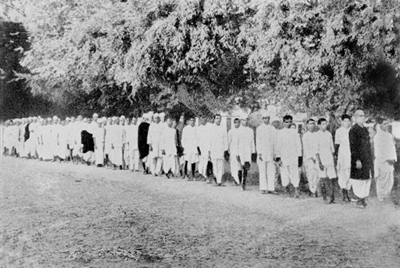
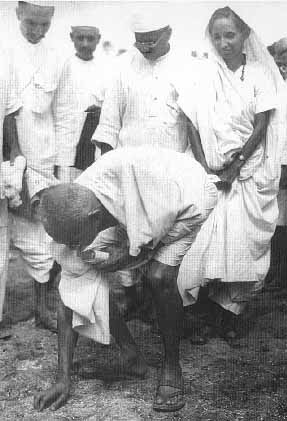
In all the stirring annals of our Freedom Movement, few events are as dramatic, inspiring and significant as the historic Dandi March led by the Father of our Nation-Mahatma Gandhi.
On one level, the March was intended to protest against the nefarious provisions of the Salt Tax imposed by the British. But there was another level that had deeper, more profound implications and gave the event a unique significance. The March, in effect, was the spark that ignited the flames of the Freedom Movement and caused the idea of mass civil disobedience to spread like wildfire across the nation.
In December, 1929,the Indian National Congress declared that total independence for India was its avowed objective and to that effect January 26,1930 ,was celebrated as Independence Day throughout the country. People everywhere enthusiastically pledged themselves to fight for “purna swaraj”. Again this background , Gandhiji under the authority of the Congress took the first step and launched the civil disobedience movement known as the Salt Satyagraha.
Serving notice on the Viceroy. Before commencing the March, Gandhiji on March2,1930, addressed a historic letter to the Viceroy. In it, he described the ruination of the country under British Rule and gave notice of his intention to launch a civil disobedience movement by symbolically breaking the Salt Tax law which in his opinion was “the most iniquitous of all from the poor man’s standpoint.” He also added: “As the independence movement is essentially for the poorest in the land, the beginning will be made with this evil.” The Viceroy’s unfeeling reply to this moving letter provoked Gandhiji to exclaim: “On bended knees I asked for bread and I have received stone instead.”
Fixing the time and the place. The place Gandhiji selected as the site for his symbolic breaking of the provisions of the hated Salt Tax, was Dandi, a seaside village in Gujarat. He decided to march the full distance of 241 miles, from his ashram at Ahmedabad, with a select band of co-workers. The appointed date: March 12, 1930.
Adding fuel to fire. The days before the March commenced, were very tense. Sardar Vallabhbhai Patel who had gone to Borsad to prepare the villagers so as to accord Gandhiji and the satyagrahis a fitting welcome when they passed through the district, was arrested at Ras on March 7. This, only added fuel to the already considerable fire. On March 9, a huge crowd of 75,000 people attended a mammoth meeting on the sands of the Sabarmati. Here, they passed a resolution in the form of a vow, in Gandhiji’s presence, to tread the same path Sardar Vallabhai had trod and not to rest in peace till freedom for the nation was achieved, adding: “nor will the Government get peace.” Echoes of the same resolve resounded all over India.
Growing support at home and abroad. Day after day Gandhiji explained his programme, answered questions, and expounded his message at prayer meetings. There was no limit to the number of visitors at the ashram and press reporters often broke the sanctity of prayer grounds to get through to him. During these days, messages of support poured in. There was a cryptic letter from a Revolutionary Party to “Comrade Gandhi”, giving him three year’s time to try his non-violence. A German doctor sent a drawing executed by himself along with a note that in far-off Germany, “a humble fellow pilgrim is praying for him and his work every morning and evening.” “God guard you”, said a New York message from Rev. Holmes. Simultaneously, serving as a bizarre counterpoint to these encouraging messages, were persistent rumours of Gandhiji’s impending arrest and deportation.
Speaking on the eve of the March. On March 11, the day before the March was to begin, the crowd swelled to 10,000 when the evening prayers were held. At the end Gandhiji delivered a memorable speech: “In all probability,” he said, “this will be my last speech to you. Even if the Government allow me to march tomorrow morning, this will be my last speech on the sacred banks of the Sabarmati. Possibly, these may be the last words of my life here.”
March 12. The Great March, which can be likened to Lord Buddha’s Mahabhinishkraman, commenced from the ashram premises on the banks of the river Sabarmati, Ahmedabad, at 6.30 a.m. on March 12, 1930. Gandhiji, staff in hand, frail, but full of energy even at the age of 61, led the 78 satyagrahis. These represented a cross-section of the people from all over the country: Andhra, Bengal, Bihar, Bombay, Gujarat, Karnatak, Kerala, Cutch, Maharashtra, Punjab, Rajputana, Sind, Tamiland, U.P.,Utkal and even Nepal. Besides Hindus, there were among them two Muslims, one Christian and two Harijans. A huge crowd followed the satyagrahis, the roads for miles and miles having been watered and decorated with arches, flags and torans.
Reactions across India. Writing under the caption ‘Departure’ in the NAVAJIVAN of March 16,1930, Gandhiji stated “Thousands of Ahmedabad citizens, both men and women, kept vigil on the night of the 11th. Thousands flocked to the ashram… We walked on between to as far as the Chandola lake. I can never forget the scene.”
Later, speaking about the Dandi March, Gandhiji said: “My feeling is like that of the pilgrim to Amarnath or Badri-Kedar. For me this is nothing less than a holy pilgrimage.”Shri Motilal Nehru drawing a historical parallel said: “Like the historic march of Ramachandra to Lanka the march of Gandhi will be memorable”, while Shri P. C. Ray compared it with “the exodus of the Israelites under Moses.”
The sight of the satyagrahis moved Jawaharlal Nehru to heights of eloquence, prompting him to exclaim: “Today the pilgrim marches onward on his long trek. Staff in hand he goes along the dusty roads of Gujarat, clear-eyed and firm of step, with his faithful band trudging along behind him. Many a journey he has undertaken in the past, many a weary road traversed. But longer than any that have gone before is this last journey of his, and many are the obstacles in his way. But the fire of a great resolve is in him and surpassing love of his miserable countrymen. And love of truth that scorches and love of freedom that inspires. And none that passes him can escape the spell, and men of common clay feel the spark of life. It is a long journey, for the goal is the independence of India and the ending of the exploitation of her millions.”
After the first day’s march which ended at Aslali,13 miles from Ahmedabad, Gandhiji said to the assembled people: “The soldiers of the first batch had burnt their boats the moment the March began.” He also vowed not to return to the ashram until the Salt Act was repealed, and “swaraj” won.
Gandhiji’s energy at the age of 61 was amazing. Daily he walked 10 miles or more and addressed public meetings. The ashram routine of prayer, spinning and writing up the daily diary was incumbent on every Marcher. “Ours is a sacred pilgrimage”, he said, “and we should be able to account for every minute of our time.” He retired at 9 p.m. still talking to people and giving interviews until he fell asleep. Long before his comrades were up, he rose and began his correspondence. At 4 a.m.in the morning he was seen writing letters by the moonlight, as his little lamp had gone out for want of oil and he did not wish to disturb anybody. At 6 a.m. there was the call to morning prayers. After the prayers, he delivered a sermon to the pilgrims on the march and answered questions. Every day, the March commenced punctually at 5.30 a.m.
Unprecedented scenes of increasing enthusiasm were witnessed throughout the March from Ahmedabad to Dandi. During his numerous speeches on the way, he exhorted people to join in large numbers, boycott foreign cloth, adopt Khadi and desist from the evil of drinking. He advised women who wanted to join the struggle, to take up the picketing of liquor shops and foreign cloth shops.
The “Duty of Disloyalty”. In the issue of YOUNG INDIA of March 27,Gandhiji gave a call to the people in an article titled the ‘Duty of Disloyalty.’
In it he bluntly declared that there was no half-way house between active loyalty and active disloyalty. He added: “Indeed, loyalty to a state so corrupt is a sin, disloyalty a virtue.” This was in keeping with the sentiments of a speech he had made in Borsad on March 18, where he said: “I regard this as a religious movement since sedition is our dharma.”
In response to this call, several village officials resigned their posts. People everywhere were overcome by a fresh wave of enthusiasm. Addressing the youth, Shri Jawaharlal Nehru said, “The field of battle lies before you, the flag of India beckons to you, and freedom herself awaits your coming.”He also added: “Who lives if India dies? Who dies if India lives?”
Shri Motilal Nehru and Shri Jawaharlal Nehru met Gandhiji at Jambusar and also marched a little distance with him. Later, after consulting him, Shri Motilal Nehru made a gift to the nation of Anand Bhavan, their ancestral house at Allahabad.
Fiery speeches by Gandhiji. Gandhiji speeches along the way were charged with emotion and spared neither the Government nor the people. His speech at Bhatgam on March 29, was introspective and as he noted in YOUNG INDIA “moved both the audience and me deeply.” He expressed agony at reported extravagances saying: “Extravagance has no room in this campaign.” He also reiterated his resolve to carry on the struggle. His ringing words were: “it will continue no matter how co-workers or others act. For me there is no turning back whether I am alone or joined by thousands. I would rather die a dog’s death and have my bones licked by dogs than that I should return to the ashram a broken man.” In the course for a speech at Navsari, he said: “Either I shall return with what I want or my dead body will float in the ocean.” Earlier, addressing the volunteers on March 28, Gandhiji had said: “We have looked upon Dandi as Hardwar. Let us become worthy of entering a place as holy as Hardwar.”
The long 241 mile trek finally ended on April 5, 1930. Along the way Gandhiji and his companions had broken journey for the night at 22 places.
On April 6, the atmosphere at Dandi was both tense and solemn. The day began with prayers. Gandhiji then nominated shri Abbas Tyabji, and after him, Smt. Sarojni Naidu, to lead the satyagraha if he was arrested.
After prayers, Gandhiji with his followers took a bath in the sea. Then at 8.30 a.m. he defied the Salt Law by picking up a lump of salt. Smt. Sarojni Naidu who was there, hailed him as a ‘law-breaker.’
The Aftermath
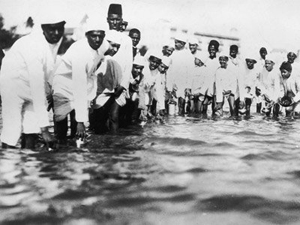
The nation defies the Salt Law. The first salvo of the battle was thus fired. Gandhiji in a statement issued after breaking the Salt Law, declared “Now that the technical or ceremonial breach of the Salt Law has been committed, it is now open to anyone who would take the risk of prosecution under the Salt Law to manufacture salt, wherever he wishes and wherever it is convenient.”
The entire nation rose as a man against what Gandhiji described as “Goonda Raj”. Millions broke the Salt Law and courted imprisonment. Salt depots were raided everywhere and the manufacture of illicit salt was undertaken. In a single raid at Dharasana, 289 volunteers were wounded because the police now used lathis and batons freely. But even the brutality of the mounted police failed to break the morale of the people. At the same time, the breaking of other oppressive laws was also undertaken.
Gandhiji moves on. Gandhiji declared to the nation: “The call of 1920 was a call for preparation, today it is a call for engaging in final conflict.” He said in a message: “At present India’s self-respect, in fact, her all, is symbolized as it were in a handful of salt in the satyagrahi’s hand. Let the first holding it, therefore, be broken, but let there be no voluntary surrender of the salt.”
British react
The Government replied by unleashing a regin of terror. By March 31, more than 95,000 were jailed. Shri Jawaharlal Nehru was arrested on April 14 and sentenced to 6 month’s imprisonment. Sporadic violence broke out in Karachi, Calcutta, Peshawar and Chittagong. The police opened fire in Calcutta, Madras and Karachi and perpetrated acts of brutality all over the country. Through all this Gandhiji urged the people to “answer this organized hooliganism with great suffering.”
Gandhiji is arrested. The battle against the “Black Regime” was at its peak when Gandhiji planned to commence the march to Dharasana. But at 12.45 a.m. on May 4, he was arrested at Karadi,3 miles from Dandi whilst asleep in his cottage. The camp where he rested was raided by the District Magistrate of Surat, with two police officers armed with pistols and about 30 policemen armed with rifles. Flashing a torch on Gandhiji, who was asleep in his bed, the British officer asked him if he was Mohandas Karamchand Gandhi. Then he was arrested under a written order under Regulation XXV of 1827, and allowed to pack up his few belongings and take time to say his prayers. Gandhiji then asked Pandit Khare, one of the satyagrahi’s, to recite his favourite hymn-Vaishnavjan, with which he had commenced his March. The members of the party then bade him an affectionate farewell by making pranams before him. Within an hour, at 1.10 a.m., he was driven away in a lorry, to Yeravda Central Prison.
Miraben, a close associate of Gandhiji commented thus on his arrest: “At the dead of night, like thieves they came to steal him away for ‘when they sought to lay hand on him, they feared the multitudes, because they took him for a prophet!”
Thus ended a glorious episode in our Freedom Struggle. The spark that the Dandi March ignited, soon kindled the flames of a movement that engulfed the entire nation and finally succeeded in achieving what Gandhiji in essence strove to accomplish at Dandi – total independence for the people of his beloved India.
SALT SATYAGRAHA SPREADS

Nationwide Civil Disobedience
Gandhiji’s arrest and internment led to hartals and strikes all over India. Some fifty thousand textile workers downed tools in Bombay. The railway workers joined the demonstration. In Poona, where Gandhi was interned, resignations from the honorary offices and from services were announced at frequent intervals. In Calcutta, the police opened fire and arrested many people. There was firing also in Delhi. On the day of Gandhi’s arrest, Peshawar was surrounded by military. India rose like one man.
In Sholapur the people held possession of the town for one week, until the martial law was proclaimed. There was trouble in Mymensingh, Calcutta, Karachi, Lucknow, Multan, Delhi, Rawalpindi, Mardan and Peshawar. Troops, aeroplanes, tanks, guns and ammunition were freely used in the North-West Frontier Province. Repression in the Punjab gave birth to the Ahrar Party.
The West awakened by Romain Rolland showed a keen interest in the Indian crisis. One hundred clergymen headed by Dr. Holmes requested Mr. Ramsay MacDonald, the British Premier, to settle amicably with Gandhi.
Raid at Dharasana: The Perfect Satyagraha
Gandhiji’s successor, Mr. Abbas Tyabji, ex-Justice of Baroda, was getting ready at Karadi for the march to the Salt Works at Dharasana. On May 12, 1930, the volunteers fell into line ready for the march, but Tyabji was arrested.
Mrs. Sarojini Naidu succeeded Abbas Tyabji. On May 21 over 2,000 volunteers led by her and Imam Saheb raided Dharasana salt depot, about 150 miles north of Bombay. Mrs. Naidu led the volunteers in prayer and addressed them briefly: “Gandhiji’s body is in jail but his soul is with you. India’s prestige is now in your hands. You must not use any violence under any circumstances. You will be beaten but you must not resist, you must not even raise a hand to ward off blows.” With Manilal, Gandhi’s son in the forefront, the throng moved forward towards the salt pans, which were now surrounded with barbed-wire stockade and ditches filled with water, guarded by four hundred Surat police with half a dozen British officials in command.
One hundred yards from the stockade the satyagrahis drew up and a picked column advanced, wading the ditches and approaching the barbed wire. “Suddenly,” observed Mr. Miller, an American journalist, “at a word of command, scores of native police rushed upon the advancing marchers, and rained blows on their heads with steel-shod lathis. Not one of the marchers even raised an arm to fend off the blows. They went down like ninepins. From where I stood, I heard sickening whacks of the clubs on unprotected skulls… Those struck down fell sprawling, unconscious or writhing in pain with fractured skulls or broken shoulders. In two or three minutes the ground was quilted with bodies. Great patches of blood widened on their white clothes. The survivors without breaking ranks, silently and doggedly, marched on until struck down.”
When the first column was gone, another marched forward. “Although every one knew that within a few minutes he would be beaten down, and perhaps killed, I could detect no sings of wavering or fear. They marched steadily with heads up… The police… beat down the second column. There was no fight, no struggle; the marchers simply walked forward until struck down. There were no outcries, only groans after they fell. There were not enough stretcher-bearers to carry off the wounded…”
“Bodies toppled over in threes and fours, bleeding from great gashes on their scalps. Group after group walked forward, sat down, and submitted being beaten into insensibility without raising an arm to fend off the blows. Finally the policemen became enraged by the non-resistance, sharing, I suppose, the helpless rage I had felt at the demonstrators for not fighting back. They commenced savagely kicking the seated men in the abdomen and testicles. The injured men writhed and squealed in agony, which seemed to inflame the fury of the police, and the crowd again almost broke away from their leaders. The police then began dragging the sitting men by the arms or feet, sometimes for a hundred yards, and throwing them into the ditches… Hour after hour stretcher-bearers carried back a stream of inert, bleeding bodies.”
Mrs. Naidu and Manilal Gandhi were arrested. Miller went to the temporary hospital where he counted 320 injured, many still insensible with fractured skulls, and others writhing in agony. Scores of the injured had received no treatment and two men had died. The Government made every effort to prevent Mr. Miller from communicating his reports to his newspapers… His story of the beating caused a sensation when it appeared in the 1,350 newspapers served by the United Press throughout the world.
Raids on Other Salt Works

Raids in succession were also made on the salt depot at Wadala, a suburb of Bombay. On May 18, some 470 satyagrahis who sent out for the raid were arrested. But the most demonstrative raid came off on June 1st , when some 15,000 volunteers and spectators participated in the great mass action. The mounted police charged into the crowd, striking heads with clubs. Similar raids took place in Karnataka on Sanikatta salt works, in which some 10,000 raiders took away thousands of maunds of salt under the shower of lathis and bullets. George Slocombe , a British journalist, who witnessed the raid on the Wadala salt depot, wrote, “The imprisoned Mahatma, now incarnates the very soul of India.”
Gandhiji Writes ‘Yeravda Mandir’ in Prison
Gandhi wrote weekly letters in Gujarati to the inmates of the ashram, containing a cursory examination of the principal ashram vows: truth, non-violence, brahmacharya, non-possession, bread labour , etc. These letters appeared in Young India and were subsequently published in book form, From Yeravda Mandir. His other literary activity was the translation of the hymns and verses of the ashram hymn book, Bhajanvali, published later by John Hoyland as Songs From Prison.
Civil Disobedience Continues
The Working Committee of the Congress met at Allahabad in June and recommended in its resolutions continuation of civil disobedience, complete boycott of foreign cloth, inauguration of a n-tax campaign, weekly breaches of the salt law, boycott of British banking, insurance, shipping and other institutions, and picketing of the liquor shops. The Viceroy promulgated drastic ordinances to counteract picketing, non-payment of taxes and tampering with the loyalty of Government servants.
Boycott and Propagation of Khadi
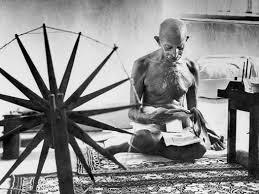
The boycott of foreign cloth, liquor and all British goods was complete. The demonstrators went in their hundreds to prison, but always there were more to take their place. Women dressed in orange Khadi saris picketed shops dealing in foreign goods. Few entered these shops. If any one attempted to enter, the women volunteer joined her hands in supplication and she pleaded; if all else failed, she would throw herself across the threshold. But those were exceptional shops which had refused to give the pledge to sell no foreign cloth and no British goods. Most of the Indian shops gave this undertaking. Only with a printed permit issued by the Congress committee dare a driver take his bales past the Congress sentries. In Bombay, 30 crores’ worth of foreign cloth was sealed by the Congress.
Every day began with a prabhat pheri.

By the autumn of 1930 imports of cotton piecegoods went down to between a third and a fourth of what they were in the previous year. The cigarettes had fallen in value to a sixth of the old figure. Sixteen British owned mills in Bombay had been closed down. On the other hand, the Indian-owned mills which had given the pledge were working double shifts. About 113 mills signed declaration, to which they agreed, to eliminate competition of mill cloth with khaddar by refraining from producing cloth of counts below eighteen. So great was the rush for khaddar that all stocks were depleted, though the production all over rose from 63 lakhs of yards to 113 lakhs of yards. The total number of khadi stores at the end of 1930 was 600, as against 384in 1929.
Women in the Forefront
The most striking part in the campaign was played by the women, belonging to all sections of society. Even the aged Kasturba Gandhi and Mrs. Motilal Nehru participated in picketing. Due to successful picketing, revenue fell by about seventy percent. The forest laws in C.P. were defined, the Government losing thereby some sixteen lakhs of rupees.
Repression by Government
On June 30, the Government arrested Pandit Motilal Nehru, the acting president, and declared the Working Committee of the Congress as an unlawful association. Thousands of people were jailed. Government by ordinances went on apace. By July, 67 nationalist newspapers and about 55 printing-presses had been shut down under the Press Ordinance. The Navajivan Press was seized and Young India and Navajivan began to appear in cyclostyle.
In June the long-awaited report of the statutory commission was issued. Its recommendations did not even go so far as to repeat the Viceroy’s vague promise of the dominion status. They provided for a strengthening of the central authority, while giving a few concessions to the provinces. The principle of “divide and rule” was carried further by its extension of the principle of communal electorates. These recommendations profoundly disappointed all parties. Men like Malaviya and Aney threw in their lot with the Congress and courted jail. In July, Observer reported “defeatism” and “demoralization of the Europeans” in India.
On July 9 the Viceroy addressed a joint session of the Council of State and the Legislative Assembly : He said,: “that by way of the conference it should be possible to reach solutions that both countries and all parties and interests in them can honourably accept”. He further assured that the declaration of the pledge of dominion status as the goal stood as before. Within a week of the Viceregal announcement a conference of the Nationalist and Independent Parties in the Assembly and a few members of the Council of State unanimously passed a resolution authorizing M.R. Jayakar to negotiate for a peace settlement between the Congress and the Government. The Viceroy agreed to both Sapru and Jayakar seeing Gandhiji, Motilal Nehru and Jawaharlal in jail.
Attempts by Liberal Intermediaries
The peace intermediaries had prolonged conversations with Gandhiji in the Yeravda jail on July 23 and the following day. Sapru and Jayakar interviewed the Nehrus in Naini prison on July 27. The Nehrus were brought to Yeravda and the joint interview took place on the 13th, 14th and 15th of August. The result was a letter signed by Gandhiji and the Nehrus, in which they said: “nor are we in a position to say anything authoritative without reference to a properly constituted meeting of the Working Committee of the Congress and, if necessary, the A.I.C.C.; but for us individually no solution will be satisfactory unless (a) it recognizes, in as many words, the right of India to secede at will from the British Empire; (b) it gives to India complete national government responsible to her people, including control of the defence forces and economic control, and covers all the eleven points raised in Gandhiji’s letter to the Vicroy; and (c) it gives to India the right to refer, if necessary, to an independent tribunal such British claims, concessions and the like, including the so-called public debt of India, as may seem to the national government to be unjust or not in the interest of the people of India.”
The Viceroy now said: “I regard the discussion on the basis of the proposals contained in the letter as impossible.”
Meanwhile repression was going on. Important Congress leaders were being arrested and the Congress committees all over India were being declared as illegal organization and their meetings were banned and their property confiscated. These measures drove the Congress underground. In the cities like Bombay, there were two governments. The vast majority had transferred its allegiance to the Congress. Its lightest nod was obeyed.
An important feature of the civil disobedience programme was a no-tax campaign. Sardar Patel who had been released, once more led Bardoli. Repressive measures by the authorities became intolerable.
The Europeans in India clamoured for still firmer measures. But Lord Irwin realizing the futility of repression stated in Calcutta in December. “However emphatically we may condemn the civil disobedience movement, we should, I am satisfied, make a profound mistake, if we underestimate the genuine and powerful meaning of nationalism that is today animating much of Indian thought and for this no complete or permanent cure had ever been or ever will be found in strong action by the Government.”
In the meanwhile the first Round Table Conference met in the shadow of civil resistance and repression in India. The King of England presided over the conference, opened on November 12, 1930.Its members, nominated by the Governor-General in Council, consisted of the Indian princes and various landlord, big capitalists, communalists and a few liberals. For nearly ten weeks the various committees met to discuss a constitution on the lines suggested by the statutory commission. The conference ended by January 1931.
It made no difference to the course of the mass civil disobedience campaign. The sacrifices and hardships of the people touched the sympathetic chord of every Indian.
Gandhiji is Released
On January 25, 1931, Lord Irwin issued a statement releasing Gandhiji and the members of the Working Committee: “My Government will impose no conditions on these releases, for we feel that the best hope of restoration of peaceful conditions lies in discussions being conducted by those concerned under the terms of unconditional liberty.”
Speaking to the journalists in Bombay, Gandhiji clarified his position: “I personally feel that the mere release of the members of the Congress Working Committee makes a difficult situation infinitely more difficult, and makes any action on the part of the members almost, if not altogether, impossible. The authorities have evidently not perceived that the movement has so much affected the mass mind that leaders, however prominent, will be utterly unable to dictate to them a particular course of action…
“What I am now anxious to clear is that even if after consultation with friends who are coming from the Round Table Conference, it is found that the Premier’s statement affords sufficient ground for the Congress to tender co-operation, the right of picketing cannot be given up, nor the right of the starving millions to manufacture salt….No amount of goodwill, especially between Great Britain and India, so far as I can see, will reconcile the public to the drink evil, foreign cloth evil or prohibition of the manufacture of salt.
“I have given three tests that are in operation, but as the public know, there are eight more points I want- the substance of independence, not the shadow. And even as the doctor names the disease after proper diagnosis, so also I will name the tree of the Round Table Conference after I have examined the fruit in the light of the eleven points which are conceived in the terms of the man in the street.”
January 26, 1931, the first anniversary of the Independence Day, was celebrated with great gusto. The release of Gandhiji and the members of the Working Committee on that day added much to the enthusiasm of the people. The momentous day was observed all over the country by holding of mass meeting which confirmed the resolution of independence, and passed the Resolution of Remembrance: “ And with this splendid and inspiring example of sacrifice and suffering in India’s cause before us, we repeat our Pledge of Independence, and resolve to carry on the fight till India is completely free.”